
Getting Started

The Fertility Institute of NJ & NY Difference
At the Fertility Institute of NJ & NY, you are a person, not a patient. Each of our patients is an individual, each journey unique, and every treatment plan is tailored to the medical requirements, needs and dreams of our patient. Your successes are our greatest joy; your disappointments are our disappointments. We are innovators, researchers, and experts on the cutting-edge of our field, but that dedication to the advancement of infertility treatment never comes at the expense of being accessible to our patients. Our staff takes a personal interest in the future of the families they are creating. Every resource and skill we have is at your disposal as we work together to foster hope and create new life.
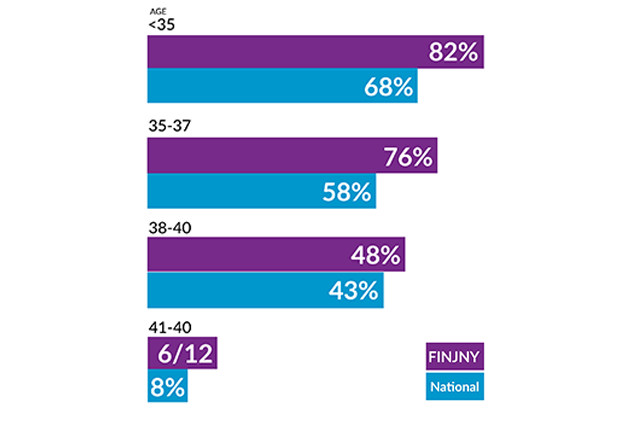
Success at the Fertility Institute of NJ & NY
We believe in personalized care backed by clinical excellence. In addition to our commitment to quality care, we have continued to provide some of the highest IVF success rates in the region, exceeding the national average in all ages categories.
Note: A comparison of clinic success rates may not be meaningful because of patient medical characteristics, treatment approaches, and entry criteria for ART may vary from clinic to clinic. The graph below highlights our 2022 final SART data by birth per patient. For more success rate information, visit sart.org
What is Infertility?
Infertility is defined as the inability to conceive a pregnancy or to carry a pregnancy to term. In clinical terms, an infertility diagnosis is generally given once couples have tried to conceive for at least 12 months without success. For women over the age of 35, the period of unsuccessful conception drops to six months before fertility is considered to be impaired and medical intervention is recommended. Women over the age of 40 may warrant evaluation in even less than six months. According to data resulting from the Centers for Disease Control and Prevention's National Survey of Family Growth, almost 11 percent of American women struggle with impaired fertility. There are a number of factors that can affect your ability to get pregnant, some of which come from the female, some from the male, and some as a result of the combination of male and female factors. These include:
- Hormonal imbalances that affect ovulation
- Fallopian tube disease
- Low sperm count or low sperm motility
- Sexually transmitted diseases
- Endometriosis
- Polycystic Ovarian Syndrome (PCOS)
- Uterine Fibroids
- Autoimmune disorders such as diabetes, rheumatoid arthritis, thyroid disease, or lupus.

Understanding Your Menstrual Cycle
The odds of conception change depending on where a woman is in her cycle, and although the exact schedule can differ from woman to woman, the following guidelines will serve as a general overview so you can know what to look for and why your doctor may be recommending a certain timeline for treatment. Typically, the entire menstrual cycle is around 28 days from start to finish and is divided into three phases:
Your First Visit
During your first visit to the Fertility Institute of NJ & NY, you will meet with a member of our care team where they will get to know you, review your medical records, and talk about your goals. Our goal is to ensure our fertility specialists have a comprehensive picture of your general medical and fertility history. If you have never had a complete infertility workup, one will be ordered so that we have all the information necessary to accurately assess your fertility potential. Together, you and your provider will discuss possible treatment options and decide on a plan of care.
Initial Workup
Your initial fertility workup at the Fertility Institute of NJ & NY will help us answer the four basic questions important in the evaluation of a patient's fertility potential:
- Do I ovulate and have enough eggs?
- Is my partner's sperm count high enough, and is his sperm motility and sperm morphology adequate?
- Are my fallopian tubes open for sperm and egg to meet?
- Is my uterus healthy and able to carry a pregnancy?
Once we know the answers to these four questions, we can tailor your fertility treatment to address any areas which may be negatively affecting your fertility. Learn more about fertility testing >

Fertility Treatments
Ovulation Induction for Anovulation
During ovulation induction we use oral, or sometimes injectable, medications to help overcome ovulation issues. We monitor your cycle via blood tests to measure hormone levels and via pelvic ultrasound to scan the ovaries to measure follicle growth and egg maturation.
Intrauterine Insemination (IUI)
IUI, commonly known as Artificial Insemination, can help patients overcome moderately low sperm count or motility, or infertility due to cervical issues, by putting sperm into the uterus at the appropriate time in the woman's cycle. It is also possible to perform IUI in combination with oral or injectable fertility medications.
In Vitro Fertilization (IVF)
IVF can overcome infertility by combining the egg and sperm outside the body and then transferring the resulting fertilized egg, or embryo, into the uterus. The procedure is used in cases where: the sperm count is very low, there is damage to the fallopian tubes, presence of Polycystic Ovarian Syndrome (PCOS), endometriosis, or certain unexplained fertility issues.
Intracytoplasmic Sperm Injection (ICSI) with IVF
ICSI is a process in which one single sperm is selected and injected into a single egg. This can be especially useful in situations where sperm quantity or motility is very low.
Preimplantation Genetic Diagnosis (PGD) and Preimplantation Genetic Screening (PGS)
PGT is an elective procedure that can be added to an IVF cycle. This innovative testing screen an embryo for the correct number of chromosomes. Abnormalities in the number of chromosomes (aneuploidy) can lead to failed IVF cycles, miscarriages, and/or birth defects. Since gender is also identified during procedures, results can be used to assist with family balancing. This technology can also be used to screen for a specific genetic disease, such as Tay-Sachs disease, cystic fibrosis, or other single-gene mutation. Learn more about PGT >